“The Gibson Girl and Her Glorious Hats”
Close your eyes for a moment and imagine a fashionable young woman strolling down a city street at the turn of the twentieth century. She is graceful, beautifully dressed, and perfectly poised. Her hair is swept high into an enormous, soft pompadour. And perched above all that magnificent hair is a hat that could never be accused of being shy.
OH, THOSE HATS! A wide brim. Cascading flowers. Sweeping feathers. Ribbons curling around the crown.
This was the world of the Gibson Girl, and more than a century later, I still find her—and especially her glorious hats—irresistible.
Who Was the Gibson Girl?
The Gibson Girl wasn't a real person. American illustrator Charles Dana Gibson created her, and her drawings appeared in popular magazines ind early 1900s. Gibson created an idealized young woman who seemed to capture something exciting that was happening at the time. She was beautiful, certainly, but she was also confident, intelligent, spirited, and independent. She bicycled. She played sports. She enjoyed society. She could be mischievous, and she certainly wasn't afraid to have an opinion.
America fell in love with her. It wasn’t long before the Gibson Girl seemed to be everywhere—from magazines and advertisements to calendars, fans, plates, pillowcases, and even wallpaper.
But as a milliner, there is one part of her unmistakable silhouette that immediately catches my attention.
What in the world were milliners supposed to put on top of all that hair?
A Hairstyle That Changed the Hat
The Gibson Girl's famous pompadour was soft, full, and piled high on her head. It was beautiful. It was also enormous. The smaller bonnets and hats of earlier decades simply weren't going to have the same effect perched above that wonderful cloud of hair. So millinery changed right along with women's hairstyles.
Brims became wider. Crowns changed shape. Hats were designed to sit gracefully above elaborate hairstyles rather than flatten them. And then came the decorations. Flowers, ribbons, bows, lace, plumes, feathers—sometimes seemingly all at once! The results could be wonderfully dramatic. I've always found this fascinating because fashion doesn't change one piece at a time. A new hairstyle influences hats. Hats change a dress’s silhouette. Social changes influence what women are comfortable wearing.
One thing leads to another, and before you know it, an entirely new look has been born.
And Then There Were the Feathers...
If there is one thing I particularly love about Edwardian hats, it is their wonderful sense of drama. These were not hats designed to disappear into an outfit. A sweeping feather could rise high above the crown or curl gracefully around a brim. Flowers might spill across one side. Ribbons could soften the entire design or create a dramatic focal point. Some hats became extraordinarily large. And somehow, beneath all of it, the Gibson Girl carried it off. Perhaps that's because the hat matched the woman Gibson had created. She wasn't timid, and neither was her fashion.
There was confidence in that silhouette!
What I See When I Look at a Gibson Girl Hat
This is where history becomes especially interesting to me as a milliner. When I look at an old photograph, fashion plate, or Gibson illustration, I don't see only a historical hat.
I start looking at the design: Where does the brim curve? How high is the crown? Why did the milliner place the flowers there? Would the feather move when the woman walked? How does the hat balance against that enormous hairstyle? And, inevitably, I begin wondering how I might interpret that same feeling in one of my own designs. I don't want to simply reproduce an antique hat stitch for stitch. What interests me is capturing its personality—the romance, elegance, extravagance, and wonderful confidence of the era—and creating something a woman today can wear and enjoy.
That's where history becomes inspiration. American illustrator Charles Dana Gibson created her, and her drawings appeared in popular magazines in
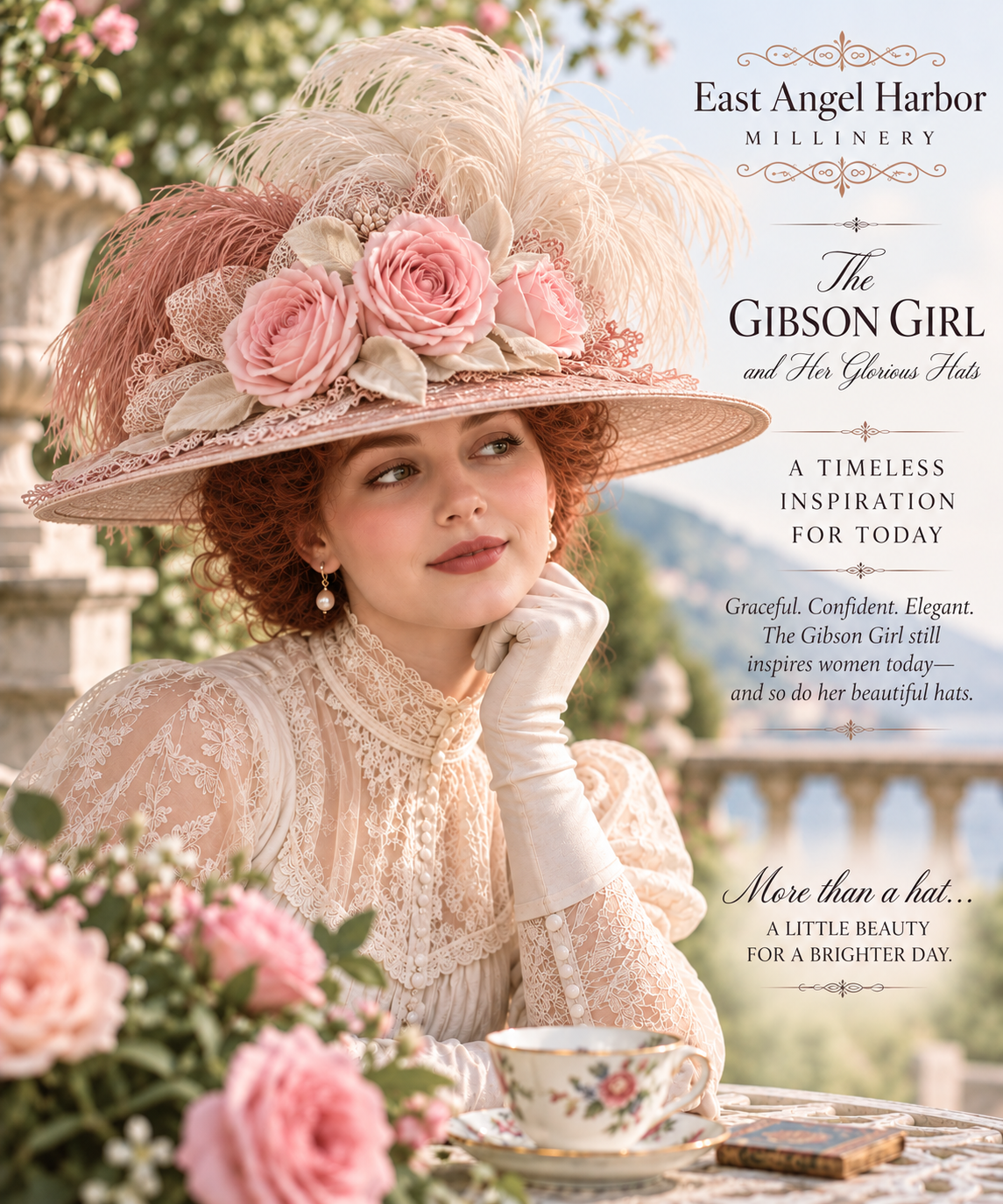
When Inspiration Becomes a Hat
Sometimes, studying an old photograph or illustration sends my imagination in an entirely new direction. I begin wondering what I would create if a Gibson Girl walked into my studio today and asked me to design a hat especially for her. Perhaps it would look something like this. A broad, platter-style brim sets the stage for soft pink roses, ivory velvet leaves, delicate lace, and sweeping ostrich feathers. Romantic and wonderfully extravagant, it borrows the confidence of the Edwardian picture hat without trying to reproduce one exactly. This particular hat began as an imagined design while I was revisiting the Gibson Girl for this article. But the more I thought about it, the more I began thinking like a milliner: How would I construct that brim? Where would I place the roses? How would those ostrich feathers move when she walked? And somewhere along the way, inspiration became a design I would genuinely love to create at my own worktable.
The Gibson Girl Gives Way to the Flapper
Fashion, of course, never stands still. After World War I, women's lives and clothing began changing rapidly. Hair became shorter. Skirts rose. The enormous hairstyles and extravagant hats of the Gibson Girl era gradually gave way to the sleek silhouettes of the 1920s. And waiting just around the corner was another unforgettable young woman: the Flapper. Her little cloche hat could hardly have looked more different from the great Edwardian creations worn only a generation before. That's one of the things I love most about studying millinery. Put an Edwardian picture hat beside a 1920s cloche, and you can almost see the world changing.
Yet the Gibson Girl never completely disappeared. More than a century later, we still recognize her silhouette. We still admire the illustrations. We still recreate her hairstyles and fashions for weddings, teas, historical events, theatrical productions, and simply for the pleasure of stepping into another era.
And milliners like me are still looking at those hats.
Perhaps We Still Need a Little Gibson Girl Confidence
I sometimes wonder whether that is part of the reason historical fashion continues to enchant us. We aren't necessarily wishing we lived in another century. There were plenty of things about the “good old days” that weren't particularly good. But we can still borrow something beautiful from them.
We can borrow the romance, the craftsmanship, and the attention to detail. And perhaps a little of the Gibson Girl's confidence. There is something rather wonderful about putting on a beautiful hat, looking in the mirror, and realizing that for just a moment you are standing a little taller.
Maybe that's why I continue to be inspired by these hats.
Or perhaps it's much simpler than that.
Perhaps I just can't resist a beautiful brim, a magnificent feather, and a hat with enough personality to enter the room before you do.
I have a feeling the Gibson Girl would understand